Wind Turbine Efficiency, Part 3: The 40.3% That Got Away

You made it to Part 3! If you haven’t already please go back to read Part 1 and Part 2.

Let's continue. From calculus, we know that to find a maximum of a given single-variable function, we take the derivative, or the slope of the function, with respect to the variable and find where the derivative equals to zero. This is because the slope of a function is zero where the function changes from increasing to decreasing or decreasing to increasing output values (aka peaks and valleys). Equation 24 from Part 2 is rather ugly, however, so let’s set the derivative with respect to k=v2/v1 (the ratio of final and initial velocity) as our plan of attack (reminder: ve, v1 and v2 are all known constants in this expression). Let’s do this now.

            25.     P=1/4rAv13(1-k2+k-k3) (substitution of k=v2/v1 into equation 24)
            26.     dP/dk=1/4rAv13(0-2k+1-3k2)=1/4rAv13(-2k+1-3k2)=0
            27.     -2k+1-3k2=0 ((1/4rAv13) is a giant multiplicative non-zero constant term, so it can be
             dumped into the zero never to emerge again (except by integration))
            28.     k=1/3, -1 (solutions to equation 27, obtained by factoring the second-degree polynomial and
             letting each set of terms equal to 0 since if ab=0, either a=0 or b=0 makes the statement true)

Obviously, a negative value of k=v2/v1 does not make sense since this requires that the wind hit the turbine and flow backwards, so we will only keep the k=1/3 value. Plugging the value for k into equation 25, we get:

                                           29.     Pmax=1/4rAv13(1-1/9+1/3-1/27)=16/27(1/2rAv13)

To interpret this result, all that must be remembered is that the total power in the original cylinder of wind was found to be Pwind=1/2rAv13 in equation 7. Substituting in this expression reveals the following relationship:

                                                                      30.     Pmax=16/27Pwind

In other words, only 16/27, or 59.3%, of the total power in a column of wind can ever be extracted by wind turbines (this is assuming 100% turbine internal efficiency relative to the 59.3% limitation). This means that there is an inherent limitation in the production efficiency of wind power relative to available energy to be harvested.

Fig. 4: Turbine efficiency cartoon (Wikimedia)


And there you have it, Betz's Law in only 30 steps.

So, knowing this, should we abandon wind power? The answer is a definite no. Wind turbines have an installation cost in both money and materials and also severe limitations as to practical operation, such as a decreasing efficiency in high wind velocities to prevent structural damage, but they are an important member of a small set of what I would consider to be true renewable energy strategies. I won’t talk about this now since I feel guilty about the density of the topic I just covered, but I will make this the topic of my next post.

If you have any questions, leave them in the comments section below and I’ll try to answer them as best I can.

Wind Turbine Efficiency, Part 2: Too Many V Terms

Welcome back! If you haven’t already, please read Wind Turbine Efficiency, Part 1: A Windy Cylinder of Power.

All calculations thus far have dealt with air in front of the wind turbine. We should take a look at what happens behind it as well. From fluid dynamics we know the following equations to be true through logical progression:

                               8.     V1=V2 (V1 is air volume before turbine, V2 is air volume after)
                               9.     dV1/dt=dV2/dt
                               10.     dV/dt=Av (equation 5)
                               11.     A1v1=A2v2

Equations 9-11 simply state that the volume of wind entering our cylinder from Part 1 must change at the same rate as the volume of air exiting the turbine from behind. This is true if we assume no changes in temperature or atmospheric pressure before to after the turbine (beyond those induced by the slowing wind, which we are calculating for now). From energy conservation, we know that if work is performed on the wind turbine, then the kinetic energy of the wind after the turbine, and accordingly the wind velocity, must be less than that before. In other words, v1>v2. The result is that A2>A1, so the wind after the turbine must effect a cone of area expanding away form the turbine blades.

Fig. 3: Air flow through a wind turbine (Danish Wind Industry Association)

Let’s try to piece apart the maximum power obtainable from the wind cylinder calculated above. Wind force is defined as follows:

                                     12.     F=ma=d(mv)/dt=(dm/dt)v+m(dv/dt) (force equation)

For simplicity’s sake, we are assuming that the wind before the turbine has velocity v1 and slows to velocity v2 after performing work on the turbine, both of which are know constant values. When wind blows through our wind cylinder, the mass of air, and as a result the effective length of the cylinder since base A is constant, changes with time. Therefore, we are not concerned with how force changes with velocity, so the m(dv/dt) term can go to zero and we can evaluate the change in wind force over the turbine as follows:

                                  13.     ΔF=(dm/dt)Δv=(dm/dt)(v1-v2)
                                  14.     ΔF=r(dV/dt)(v1-v2)=rAve(v1-v2) (from equations 4 and 5)

A new variable has been introduced in equation 14, namely the effective velocity ve, which corresponds to the wind velocity that the turbine experiences as part of work production (in other words, if the wind were to lose all kinetic energy after contacting the turbine, a wind velocity of ve would generate a quantity of power the same as from wind with velocity v1 slowing to v2). Concerning the power obtained from the change in force, we know that since the change in wind force is equal to the force exerted on the turbine, power can be calculated as follows concerning the wind contacting the turbine:

                         15.     W=FL (instantaneous work equation, L is analogous displacement here)
                         16.     dW/dL=F, therefore dW=FdL
                         17.     P=dW/dt=d/dt(FdL)=F(dL/dt)=Fve (power equation)
                         18.     P=rAve2(v1-v2) (from equation 14)

From expanding equation 4 to accept that the wind velocity after the turbine is not zero, we obtain the equation:

               19.    P=1/2(dm/dt)(v12-v22) (this is just the difference in kinetic energy with changing mass)
               20.    P=1/2rAve(v12-v22) (from equations 5 and 6, parallel to equation 7)

Now we have two different equations for power, one from the work equation and the other from the kinetic energy equation! Setting these equal to each other, we obtain the expression:

                   21.     P=1/2rAve(v12-v22)=rAve2(v1-v2)
                   22.   v=1/2(v1+v2) (simplification of equation 21 using (v12-v22)=(v1+v2)(v1-v2) identity)

This equation tells us what the relationship between the effective velocity ve and the initial and final wind velocities v1 and v2 are. Specifically, the relationship is that the effective velocity is the average of the initial and final wind velocities. Using this relationship, let’s redefine the kinetic energy-derived power equation in terms of v1 and vin preparation for calculating maximum power.

                            23.    P=1/2rAv(v12-v22)=1/2rA(1/2(v1+v2))(v12-v22) (from equation 20)
                            24.    P=1/4rAv13(1-(v2/v1)2+(v2/v1)-(v2/v1)3) (simplification of equation 23)

Things are starting to get exciting! Read on to Part 3 to finally start calculating the external efficiency limitation of wind turbines, and let me know any questions in the comments below.

Wind Turbine Efficiency, Part 1: A Windy Cylinder of Power

When people think of renewable energy, probably what comes to mind is a mixture of solar panels, wave motion generators, geothermal plants, hydroelectric dams and wind turbines. Of these, the two most associated with the image of a sustainable society are probably solar panels and wind turbines. That’s why when I caught a glimpse of this wind farm while at the Jersey shore, I felt like I had been transported into some sort of futuristic society apart from our own. 

Fig. 1: Wind farm near Atlantic City (personal photo, hence the quality)

Assumedly, we all know that every energy-harvesting method has efficiency limitations, even though some people like to pretend they don’t. With solar panels, calculating efficiency can be complicated as it comes down to a matter of quantum efficiency, but the efficiency limitations of wind turbines, also called Betz’s Law, can be readily calculated with some physics. Let’s explore this.

(Note: though not particularly difficult conceptually, this derivation is math-heavy. I will do my best to explain the underlying logic as we go along. Also, this explanation will be separated into three parts so that your eyes don’t bleed from the endless stretch of math. Backbone calculations for Betz’s Law come from the Wikipedia article and this MIT presentation, but I hope you will find that my explanation, though lengthy, is more intuitive than these sources. Enjoy!)

Let’s start with calculating how much power there exists in a cylinder of wind with base area A corresponding to the arm span of the wind turbine.

Fig. 2: Cylinder with base A and wind influx at velocity v (MIT)

                          1.  KE=1/2 mv2  (kinetic energy equation)
                   2.   KE=W (work-energy equation)
                   3.   P=d/dt(W)=1/2(dm/dt)v2+mv(dv/dt)  (power equation, product rule)

For equation two, let’s assume all work is converted to electrical energy, not friction or blade deformation or other stuff. Now in equation three, what normally happens is that the dm/dt term, or the change in mass over time, is assumed to be zero, producing the familiar mv(dv/dt) or (d(mv)/dt)v or Fv term associated with power. Instead, let’s assume that the air cylinder has a constant known speed v1. Therefore, the term mv(dv/dt) goes to zero, and we are left with equation 4:

                                                                   4.  P=1/2(dm/dt)v12

From fluid dynamics, we know that

                                                         5.  dm/dt=(m/V)(dV/dt)=r(dV/dt)

or that the mass per volume, density, multiplied by the change in volume over time is equal to the change in mass over time. Makes sense, right? This is essentially just dimensional analysis. With constant wind cylinder base A and changing length L, change in volume over time is defined as

                                                         6.  dV/dt=d/dt(AL)=A(dL/dt)=Av1

Combining equations 4, 5 and 6, we get the general power equation for a cylinder of wind to be

                                                                       7.  P=1/2rAv13

where r is density, A is cylinder base area (also area of turbine span) and v is a constant wind velocity. 

I’ll stop the first post here since it’s a good spot to take a break. Read on to the next post to learn how to calculate the effective wind speed acting on a wind turbine, and let me know in the comments below if you have any questions.

The Logic Behind an Era of Safe Canning

Canned food is something that most everyone is familiar with. From canned sardines to peaches to condensed milk, canning food is a useful preservation method for our favorite foods. Better food preservation in turn means that the foods we love are available year round. Iconically, the ridged metal can comes to mind, but there are other forms of canning that involve glass jars with metal lids used primarily for home canning but also seen sometimes in stores.

Fig. 1: A sample of canning styles (Best in Packaging)

Many families can their own excess garden goods at home to eat later; according to the CDC, 1 in 5 American households participate in home canning [1]. There are two main sterilization methods used in home canning, one involving boiling the cans and the other involving high temperatures as well as high pressure [2]. Heat kills bacteria, mold and other bad stuff for reasons previously discussed in Party Science, Part 3: The Tasty Grub. However, for the same reason that bacteria are killed by heat the flavor of the preserved food may be affected as well. Pressure kills bacteria possibly as an effect of the expansion of dissolve gases within bacterial cells [3]. Acidity is another factor that affects bacterial survival, and it has been found that acidic foods inhibit the growth of pathogenic bacteria enough to permit the use of High Pressure Processing (HPP) as the only additional sterilization technique while basic foods such as meats require heat treatment as well [4]. 

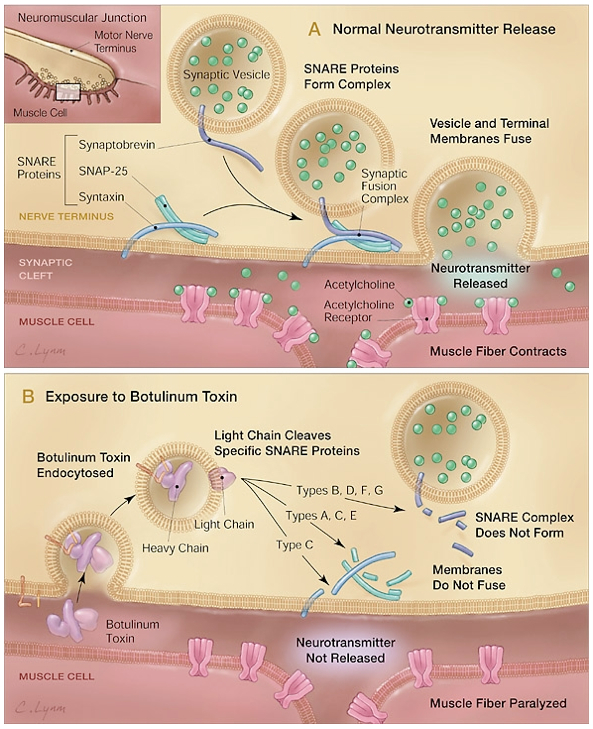
In our current era when canning is considered a generally understood science, it is uncommon to hear of botulism cases from canned foods, especially those produced commercially. Botulism is the name of an illness caused by Clostridium botulinum bacteria that generate botulinum toxin. There are eight different forms of botulinum toxin labeled types A through G (botulinum toxin C is divided into C1 and C2), of which type A is the most potent and types A, B and E are associated with human botulism. Botulinum toxin is one of the most poisonous known biological substances and also happens to be the active ingredient in Botox injections. Botulinum toxin binds to receptors on the presynaptic surface of neurons and is accepted into the neuron where it interacts with proteins related to acetylcholine vesicle transport to prevent the neurotransmitter’s release [5].

Fig. 2: Botulinum toxin mechanism of action (Student Pulse)

Symptoms of botulism are typically those related to an impaired nervous system, such as blurred vision, muscle weakness, slurred speech, drooping eyelids and difficulty swallowing. The presentation of these symptoms after possible botulism exposure is an emergency situation as antitoxins exist to treat botulism if administered promptly and progressed botulism may be fatal due to respiratory system paralysis [6]. 

But botulism and other canning-related illness cases today are rare and for the most part, the effects of canning have been positive for human survival during harsh times and the winter season. I for one love having corn, my favorite vegetable/grain thing, available all year round, and for that I am thankful we have this technology. How about you? Let me know what you think in the comments below, and check out this link to an instructional video if you are interested in canning your own foods at home. 

A Bit on That Shampoo Vitamin

Apart from the well-known vitamins like vitamin C and vitamin D, there are others that are only known in context or perhaps not known at all. Take vitamin K for example. Did you even know there was such a thing? If it weren’t for its bizarre role in blood clotting, I wouldn’t have either. Another one most people only know a bit about is vitamin E. I most associate this vitamin with shampoo because a number of soaps advertise its antioxidant properties as the secret to model-like hair. But questionable advertisement schemes aside, vitamin E does play roles in human health so let’s learn a little about it, shall we?

Though it sounds singular, vitamin E is actually a class of eight fat-soluble antioxidant compounds, all of which contain a chromane ring with a 2-hydrophobic side chain (four compounds with saturated side chains (tocopherols), three with trans double bonds (tocotrienols)) and a 6-hydroxyl group. Varying positions of methyl functional groups around the phenyl portion of the chromane ring is what separates the alpha-, beta-, gamma- and delta-tocopherols as well as the tocotrienol subtypes. 

Fig. 1: Vitamin E subtypes with sidegroup key (American Oil Chemists' Society)

All vitamin E forms exhibit antioxidant properties due to the 6-hydroxyl group’s ability to offer its hydrogen as humble tribute to wandering radical aggressors. The resulting vitamin E radical is stabilized by the electronic properties of the adjacent phenyl ring through delocalization as to be relatively unreactive. In plants, vitamin E is commonly found in chloroplasts where they protect against reactive oxygen species (ROS) produced as byproducts of photosynthesis. In humans, vitamin E plays a similar role. Vitamin E is known to incorporate into cell membranes where it is thought to protect against cellular damage caused by radicals present environmentally or resulting from metabolism by reacting with radicals before they are able to oxidize lipids and other cellular components. Regarding antioxidant ability, alpha-tocopherol has been shown to scavenge radicals faster than lipid substrates can be targeted [1]. 

The most biologically relevant form of vitamin E in humans is alpha-tocopherol, which is selectively ushered into use around the body by the alpha-tocopherol liver transfer protein, while gamma-tocopherol is suspected to hold importance as well though details are currently unknown [2]. A deficiency of vitamin E may result in neuromuscular and neurological problems, retinopathy or anemia, and excessive consumption of vitamin E may cause difficulty clotting [3]. Vitamin E is present in a number of vegetable oils, though processed vegetable oils contain lower tocopherol content due to damage during refining, leafy greens, nuts, seeds, sweet potatoes, avocadoes, eggs, liver and fortified breakfast cereals [4], many of which are typically present in a normal healthy diet. The recommended daily intake of vitamin E is 15 mg for adults, 11 mg for children ages 9-13 and 6-7 mg for children ages 1-8. Now you know stuff about this not well known vitamin, so go tell a friend and make sure they know too!

For more information on vitamin E, check out this description by the American oil chemists’ society (same as ref. 1). It’s a tad technical, but highly informative and an interesting read.

Party Science, Part 3: The Tasty Grub

If you haven't already, please check out Party Science, Part 1: The Beats and Party Science, Part 2: The Lights.

To me, a party isn’t a party unless there’s food involved. Cooking and eating food is something that we all participate in on a daily basis, and the best food is usually to be had at parties. Let’s continue with the final installment of Party Science, Part 3: the Tasty Grub.

The creation of good food is closely related to a number of chemical reactions that make plant matter easier to eat, degrade potential toxins and impart a level of yumminess. From molecular kinetics, we know that the kinetic energy of molecules is proportional to temperature by the following equation:

                       1. E=nCvT, Cv=4.179 J/g°C for water (Chemical Principles, Zumdahl)

Therefore, by increasing the temperature of a foodstuff during cooking, we are increasing the kinetic energy and average molecular translational/rotational speeds and vibrational frequency. The result: destruction! As kinetic energy overcomes the hydrogen bonding energy of proteins such as enzymes, they begin to unfold and denature, losing their conformation and functionality. A classic example of this process is the denaturation of runny raw egg white proteins to produce the rubbery cooked egg white more commonly eaten than the former (deviled eggs anyone?). The degradation of structural proteins also plays a role in softening meats like steak during cooking (this process can occur faster at lower temperatures if enzymes that degrade proteins, such as those in pineapples and papayas, are used in a marinade to lower the activation energy of protein degradation). With plants, heating can denature certain proteins or compounds that are toxic to humans, increasing edibility. Heat also encourages the hydrolysis of cellulose [1] and starches. We experience this process through the soft texture of a baked potato.

As I’m sure you know, cooking also adds flavor to raw foodstuffs through a number of processes. One such process is caramelization, wherein sucrose inverts to produce fructose and glucose molecules that then undergo various reaction pathways to produce volatile, colored and flavorful compounds [2]. This process is notable in flans and apple pies. Another is the Maillard reaction, wherein sugars react with amino acids to again undergo various reaction pathways to produce tasty molecules [3]. The Maillard reaction is best known through the browning of cooked meat.

Fig. 1: The Maillard Reaction (Lynne Swerhone)


So far what has been described are all processes that have been in play for thousands of years, but what can chemistry offer to change the ways we prepare food? Well, if you’ve ever warmed up some cheese dip, then you know of at least one. Microwave ovens use microwaves (unsurprisingly) to warm up food by introducing a fluctuating electric field component that a water molecule’s dipole continually attempts to reorient with [4]. Chemistry has also fostered advances in modern food art and molecular gastronomy. If you ever use fruit juice boba as an ice cream topping or in mixing drinks, those are made of fruit juice mixed with calcium salts and dropped in sodium alginate, a soluble cellulose salt derived from brown algae (Fig. 2). When the sodium ions are replaced by aqueous calcium ions, insoluble calcium alginate is generated to seal in the juice drop in a process called spherification.

Fig. 2: Sodium alginate spherification (Molecular Recipes)


Thermodynamics has also brought us freeze drying through knowledge of phase diagrams and water sublimation [4]. The product is various forms of fruit and vegetable snacks, a healthy substitute for traditional party chips.

In many ways, party food is made to impress. Science helps us explain our current cooking techniques, and a good knowledge of these can allow for improvements and new innovations to reinvent regular party foods. With the music playing, the party lights on and the food ready to be served, your party prep is done so invite your friends and enjoy!

Below I am posting a cool video on how to make mojito spheres using molecular gastronomy, so check it out! And please tell me your thoughts in the comments below.


Party Science, Part 2: The Lights

If you haven't already, please read Party Science, Part 1: the Beats.

So, now that we’ve got the beats, what’s next? How about we get some lights to set the mood. Today’s installment: the lights.

Again we’ll start with a simple question: what is light? Simple question, not so simple answer. To skip a lot of gritty stuff, let’s just start with the premise that light is a form of electromagnetic radiation consisting of orthogonal electric and magnetic field components and behaving as a transverse wave while also as a particle… yeah. Anyways, there are many types of light bulbs that we can use for different effects. For typical houselights, incandescent bulbs with tungsten filaments that utilize blackbody radiation were used until recent years. Currently, compact fluorescent light bulbs (CFLs) are popular for efficiency reasons with LEDs on the rise. CFLs work by ionizing argon gas and mercury vapor with tungsten filaments by thermal electron emission to produce UV radiation. The UV radiation is then converted to visible white light by phosphors either on the bulbs or on their housing [1]. LEDs utilize the junction between semiconductor material doped with electron rich or electron poor elements relative to the semiconductor valence number (p-n junction) to produce light as the electrons from the negatively-doped material fall into lower-energy electron "holes" in the positively-doped material. With these typical lights we have some basic lighting. Now what are we going to do about colorful lights for that true party feel? The college DIY option would be to put colored plastic or something over house lights to get the same effect as a colored bulb at a fraction of the cost!

Fig. 1: Procedure for colored lamp perfection (Dornob)

But how does doing this produce colored light? The first thing to notice is that the colored filter is, in fact, colored (huh, imagine that). What this indicates to us is that whatever the material is made of or coated with, it is only transmitting light that comprises the observed color. In other words, the material is absorbing a portion of the visible spectrum of light and we see a net color as a result of this absence. This could be due to a number of factors, for example the presence of transition metal compounds or conjugated organics, but the general property that allows a material to absorb light is a possible electron energy state transition corresponding to a frequency in the visible spectrum. When applied, the colored filter acts on the white light emitted from the light source, filtering out the characteristic absent spectrum and producing a net color. And with our bargain colored lights in place, how about we go for a special effect to top it all off. Let's use some blacklights. Blacklights are fluorescent lamps tubed in black-coated glass to absorb most visible light and coated in phosphors that permit only UVA light (not UVB, which causes sunburn, or UVC, which is filtered out by our atmosphere naturally and would give you super sunburn, a.k.a. cancer) to exit. The UVA radiation produced interacts with phosphors in white clothing from laundry detergents, with natural phosphors in teeth and nails and with fluorescent clothing to produce the psychedelic colors that are associated with blacklights [2]. With beats and lights, our party is going strong.

Below I’ve posted a video of Russian hip hop artist Kristina Si that depicts multiple types of lights employed at a party. Take notes people.