Fish Poisons for Anesthesia

I stumbled across a bizzarre video in my recommended videos feed on YouTube yesterday that shows a goldfish getting surgery on his head growth blocking his vision (Note: this video is not for people who are squeamish, although there is no blood):


The video was an interesting find overall, simply because it had no actual correlation with any videos in my watch history. I haven’t watched videos on fish or surgery, so to be recommended with a video featuring both was unusual. To be honest, while I was engrossed by the goldfish surgery, what made me keep watching was the maker, Colum’s Aquaponics’, use of clove oil to sedate the fish.

This brought two thoughts to my mind. The first was that clove oil has been recommended by traditional herbal medicine for toothaches. Typical application may have entailed chewing a clove or putting it between the gums and cheek next to the painful area. According to Colgate, clove oil has also been on the rise as a form of alternative medicine for oral pain in recent times as well [1]. Clove oil contains the chemical eugenol that is responsible for its anesthetic properties and is also used in refined form for modern dental applications [2]. Eugenol is a substituted guaiacol, making it related chemically to other plant compounds like vanillin though with very different effects [3]. Seemingly unrelated, this link between analgesia in humans and anesthesia in fish makes the use of clove oil to numb a surgery appear plausible to me, though a stretch.

Fig. 1: Eugenol, a fish anesthetic found in clove oil (Wikimedia)

The second was that in ancient Hawai’i, there was a method of fishing that involved lacing a stream or tide pool with a plant tincture to sedate the fish and cause them to float to the surface. The plants used included ‘ahuhu (Tephrosia purpurea) containing the fish toxin tephrosin and ‘akia (Wikstroemia oahuensis) [4(published in 1921, source must be treated as a work of its time),5]. Looking at some pictures of ‘akia on the internet, I immediately recognized the plant to have grown all over my elementary school campus back home. That’s pretty weird to think about, but it also makes me feel like I’ve missed out on an opportunity for some fun experiments.  

Fig. 2: 'Akia plant leaves and flowers ('Imiloa)

Hawai’i is not the only place to have practiced poison fishing, though in general the practice is considered destructive and paralleled to other wide-effect fishing methods like blast-fishing. And of course, the limited reach of poison fishing would be no match for the current global demand for fish. Yet while this fishing technique has been passed by in modern times, the plants and chemicals once used for fishing may now find new applications, namely in fish anesthesia for aquatic veterinary care.


I hope you enjoyed this short blurb on the interesting topic of fish anesthesia, and be sure to leave a comment and share your thoughts on the post. These past few weeks have been busy in school, and the first wave of midterms (UPenn doesn’t understand the term “midterm”) has started to hit. I do believe I will be able to post at least every other week, however, as seems to be my current posting schedule, so be sure to look out for future posts. As always, thanks for reading!  

A Prediction of Marine Plastic Debris Growth

Although it is common knowledge that plastic waste finds its way to the ocean en masse as evidenced  regions of high marine debris such as the great Pacific Plastic Gyres, there are few statistics that put exactly how much plastic enters the oceans into frame. A study published in February of this year looked to do exactly that, estimating that in 2010 an approximate 4.8-12.7 million metric tons of plastic entered waterways over 192 coastal countries that year.

This estimate was generated by taking into account local statistics for waste generation per capita and population growth trends to predict the amount of trash that shoreline countries produced within a 50 km region from the coast. An approximation of 11% plastics content for the produced waste was then applied, and transformations were imposed to convert total plastic waste to mismanaged plastic waste and finally to marine plastic debris. The authors of the study state that their estimate is one to three magnitudes higher than estimates made based upon gyre plastic content and justify this by reasoning these other estimates to only account for buoyant plastics. However, this large discrepancy between the predicted value and others brings the accuracy of the estimation into question. In the materials and methods section, the described transformation from mismanaged waste to marine waste was arbitrarily set at a percentage set of 15%, 25% and 40%, values that were deemed conservative based on a described estimation for the San Francisco Bay area.

Fig. 1: Projected plastic marine debris entering the ocean from 2010 on (Article in Discussion)

The study also estimated based on the same model that a cumulative 100-250 million metric tons of plastic waste would enter the ocean by the year 2025. This range was based on an extrapolation of population growth and plastic waste content growth rates in the past, and for this reason may be brought under scrutiny considering emerging efforts to stifle plastic waste pollution. However, the numbers produced in this study still has shock value, which lends them importance. Knowing that these enormous numbers are estimated based on current and past trends should in itself be a wake-up call since the implication is that our current lifestyle is unsustainable and resonates into the foreseeable future. In other words, this study is a call to action for all countries to set measures in place that will curb marine pollution currently and protect our future oceans.

The study goes into further detail about the extent to which efforts to reduce plastic waste in the near future will affect the amount of plastic trash that ends up in the world oceans and also gives a more detailed breakdown of the contributions of each country to marine plastic debris. It is definitely worth checking out and can be found in full text here. Thanks!

Approaching Herbalism from a Scientifically Literate Perspective

Is there really a founding for believing in herbal medicine? This seems to be a question many Americans are asking in a time when the concept of “human is better” is waning in favor of a return to an attitude that acknowledges we have a lot to learn from nature. Much of herbal medicine may seem like hocus-pocus, but scientists are not as against herbalism as some would think.

A first thought when someone mentions herbal medicine might be something along the lines of dried seahorse and mummified gecko. This is especially true for Americans where there is a high Chinese cultural medicine presence and where such practices are often caricaturized by the media. However, not all herbal medicine is so strange. Some common examples of herbal medicine practice could be honey-ginger tea for a sore throat and aloe (Aloe vera) for sunburns, both of which can be commonly bought in major store chains. As it turns out, much of the world uses some form of herbalism [1]. This shouldn’t come as a surprise. It is against human nature to accept illness as it comes, so wherever there are people there is likely to be medicine as well. But living in the time we do, both traditional herbal medicines and contemporary scientifically produced medicines are readily available. So which should we choose?

Fig. 1: Herbal medicine utilization by country (ClubNatu, same as source 1)

Herbal medicine is steeped in traditional medicine practices that developed before the scientific method and its instruments were available. Yet even so, many herbal remedies have come about through a rather logical process. Take even a fictitious, highly religious pre-scientific society where medicines are attributed to gods. If a medicine doesn’t heal its patient, then the instinct is to throw it out primarily because it’s useless and perhaps also because it makes the gods look bad. Our ancestors were smart enough to develop a working knowledge of herbs through thousands of years of trial and error, a highly valued logical test still used today in medicine development.

The argument some give in favor of a return to herbal medicine is that it’s more “natural” than modern synthetic drugs. This is not a well-based argument from a scientific perspective. Instead, we should consider factors such as effectiveness, side-effects, general safety of the herbs and the ecological impacts of its widespread prescription, each of which must be individually assessed per herb. The effectiveness of herbal remedies is a subject of increasing research attention as many have proven to possess clinical efficacy. Aspirin, for example, emerged from a more mild treatment of salicylic acid, a chemical found to exist in the bark of the white willow (Salix alba) tree used in traditional medicine. It has recently become a growing practice to scientifically test a wide number of natural products and traditional remedies as a high-throughput system for scouting out potential new treatments. Some herbal remedies have also been found to offer their effects with less side effects than modern medicine [2]. This could be due to a plethora of possible reasons including active dosage or the presence of other compounds to neutralize negative effects.

Fig. 2: Most popular natural products (including herbs) in the United States (NCCIH)

So where do herbal medicines fall short? All medicines have their associated risks, but a lack of herbal toxicity knowledge and of prescription guideline enforcement brings into question the safety of some herbal medicines [3]. The ecological effects of manufacturing herbal medicines must be considered as well. Paclitaxel, a drug with anti-tumor properties listed on the World Health Organization’s List of Essential Medicines, is a natural product from the bark of the Pacific Yew (Taxus brevifolia) tree [4]. However, wild-crafting this compound would devastate the tree population. Thus there is an inherent economic limitation on herbal paclitaxel, and so the synthetic generation of this natural compound is now the main route of production.

Herbal medicine is a topic that has been making a comeback under the realization that we have much more to discover about our medical pasts through a scientific approach. Personally, I am inclined to believe this is a step in the right direction since it is never bad to know more about plants that could potentially save our health. After all, it takes just one paclitaxel to make the search worth it. Social opinions on herbalism as a form of alternative medicine are shifting towards the positive, and as scientifically educated individuals we should keep ourselves updated on this movement.  

Birthday Borax and An Explanation of Crystal Nucleation

For my birthday a while back, a friend of mine gave me food coloring, a box of borax and spools of thread. I asked what they were for, and she said crystals.

Fig. 1: Borax crystal growing birthday gift (orig.)
Of course! I hadn’t ever seen people grow borax crystals before, only sugar or salt, so I looked up a tutorial on YouTube. The procedure was pretty standard: heat water up to near boiling, dissolve the borax, insert a pipe cleaner or thread and wait overnight for the solution to cool down and precipitate out crystals. But while the procedure is simple, the science behind nucleation is more complicated and pretty interesting.

In order for a crystal to form in solution, molecules of a substance must conglomerate to an adequate size to encourage the spontaneous coordination of more molecules. A cluster of this adequate size is called a "nucleus," and the process of its formation is called "nucleation." Clusters that are not large enough to be nuclei are called "embryos." The nucleation process can be described in terms of Gibbs free energy, which accounts for both enthalpy, related to the nucleus’ internal energy, and entropy. Gibbs free energy is given by the equation

                      1.       ΔG=ΔH-TΔS (H is enthalpy, T is temperature in Kelvins and S is entropy)

For a newborn crystal born homogenously (meaning suspended in a medium without contact with other surfaces), there are two main energy changes that are occurring. The first is a lowering of molecular energy due to the formation of attractions between coordinating substance molecules for reasons described in Why Cold Drinks "Sweat". This change in energy can be describe by the equation

                  2.       ΔG=VΔGv (V is volume, ΔGv is the change in internal energy per unit volume)

To find ΔGv, we will assume that the crystal-solution system is cooled to slightly below the substance's melting point, Tm. At this small undercooling, ΔH and ΔS can be approximated as temperature independent [1]. But first, at Tm the difference in free energy ΔG between a substance’s solid and liquid forms is 0. Therefore,

                                                                      3.       ΔGm=ΔH-TmΔS=0
                                                                      4.       ΔSm= ΔH/Tm

Now, assuming that ΔH and ΔS are temperature independent, we can use the same expression for entropy as used at Tm to find the value of ΔGv. While we’re at it, let’s assume the crystal nucleus is spherical for simplicity’s sake. The following are therefore true:

          5.       ΔGv=ΔHfv-TΔS= ΔHfv-T(ΔHfv/Tm)= ΔHfv(Tm-T)/ Tm= ΔHfvΔT/Tm (from equations 1 and 4)
          6.       ΔG=VΔGv=4/3πr3(ΔHfvΔT/Tm) (from equations 2 and 5, Vsphere=4/3πr3)

The second energy change occurring is an increase in a newborn crystal’s energy because the surface of the crystal is disrupting bonding in the liquid medium around it. This change can be described as

          7.       ΔG=Aγs=4πr2γs (A is the nucleus’ surface area, γs is the surface free energy value
           characteristic of the medium-solid interface)

This expression is just the disruption free energy per unit area multiplied by the surface area of a sphere. Together, these two energy changes dictate nucleation. Putting the two expressions together, we get

          8.       ΔGhom=VΔGv+Aγs= 4/3πr3ΔHfvΔT/Tm+4πr2γs (ΔGhom indicates that this equation is for
           homogenous nucleation)

This equation is very useful and can be used to describe nucleation events from borax crystals precipitating to homogenous cloud formation. To tease a little more information out of equation 8, let’s see how ΔGhom changes in response to a substance clump slowly growing in radius. This rate of change corresponds to the derivative of ΔGhom with respect to radius r [2];

                                                             9.       d(ΔGhom)/dr=4πr2ΔGv+8πrγs

The point where ΔGhom no longer changes with r corresponds to the peak on the following graph of equation 8 and its component parts, equations 2 and 7.

Fig. 2: Free energy of nucleation as radius increases (Materials Science and Engineering, an Introduction)
Equation 2 is shown as a decreasing curve because ΔHf is negative for crystallization. This makes sense because as a material crystallizes, energy is lost to its surroundings, so ΔHf must flow out of the system. To find the critical nucleation radius,

                                           10.   d(ΔGhom)/dr=4πr2ΔGv+8πrγs=0 (from equation 9)
                                           11.   r*=2γs/ΔGv

Plugging the critical radius into equation 8 and extracting the negative from ΔHto avoid confusion, we get

                                  12.   ΔG*hom=-4/3π(2γs/ΔGv)3ΔGv+4π(2γs/ΔGv)2γs=16/3πγs3/ΔGv2

This expression describes the magnitude of the energy change needed to get a molecular cluster up to the size of the critical radius r*, a sort of activation energy [3].

However, homogenous nucleation is relatively difficult compared to heterogenous nucleation, as I’m sure you’ve probably heard. Heterogenous nucleation occurs when a nucleus forms on a surface, such as a dust particle for clouds or thread for nucleating borax crystals. Because of the complexity of finding heterogenous nucleation equations due to complex volume and surface area terms as well as extra surface energy considerations, I will not be posting these calculations. The calculations can be found in reference 3, but the summarized result is that the critical radius in heterogenous nucleation remains the same as with homogenous nucleation while the nucleation free energy lowers and makes the nucleation process more accessible. This is why minimizing dust or rough surfaces is important for growing larger crystals rather than clusters of small ones.

What has been described above is just a small bit of the complexity of crystal growing. Knowledge of nucleation rates and crystal growth is widely used in processes such as tuning metals to have properties fit for specific purposes or growing single-crystal silicon for computer processors, and I’m sure this information will come up again on later posts. But mild difficulty of math aside, it’s cool stuff, huh? As a treat for reading through this post, watch this fun Minute Earth video on the homogenous nucleation of clouds and see if you recognize some of the concepts we discussed.


I’m planning on growing some borax crystals soon, and when I do I’ll likely write an experiment post about it so be sure to come back and check that out. I’ve already had my first few days of classes and so far it seems that I will be able to continue posting once a week, likely on Sunday or Monday. As always, thanks for reading and I’ll be posting new stuff soon!

It's Just Plastic (But What IS Just Plastic)

I have a question for you. We use the stuff all the time, but do you really know what plastics are? I mean really know. I definitely didn't until this past year when I took a course on materials science that covered the nature of polymers beyond what is traditionally taught about just joining a bunch of monomers together into strings. So let’s take a closer look at a material that has revolutionized the modern age.

Plastic is a broad term for a number of synthetic polymers with varying structures, properties, origins and chemical compositions. The properties of plastics vary according to three major factors: chemical composition, tacticity and structure. Chemical composition as a factor is fairly obvious since the different types of plastic we make vary in make up. Composition affects properties of a plastic such as the range of temperatures in which it maintains its structure. Polyethylene’s (PE, No. {2,4}) melting temperature (Tm) is around 115-130°C while polypropylene’s  (PP, No. 5) Tm is around 130-170°C. The only difference between these two polymers is an extra methyl group every other backbone carbon in the case of PP. Chemical composition also informs how a polymer is produced. Polyethylene terephthalate (PETE, No. 1), the plastic most water bottles are made of, is synthesized through the transesterification of terephthalic acid and ethylene glycol while many other polymers such as PE, PP and polystyrene (PS, No. 6) are produced by free radical polymerization. Copolymers, or polymers made with more than one monomer type, also exist in a variety of forms (block, graft, random and alternating) with more limited usage.

Fig. 1: Free radical polymerization of PS (California State University, Dominguez Hills)


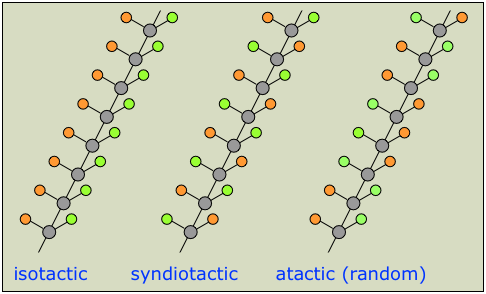
Polymer tacticity is another property of plastics, but one you usually don't hear about. Tacticity relates to the organization of monomer units within polymer strands. There are three categories of polymer tacticity: isotactic, syndiotactic and atactic polymers in order of increasing variability. Isotactic polymers are comprised of monomer units all connected in the same way to each other. Syndiotactic polymers have every other monomer unit in the same orientation and atactic polymers are oriented any which way.

Fig. 2: Isotactic, syndiotactic and atactic polymer models (University of California, Davis)

Different synthesis methods affect the tacticity of the produced polymer,  for example the use of metal-catalyzed polymerization reactions may enact more stereospecific polymer synthesis [1]. Tacticity mainly affects whether or not a polymer can form crystalline regions. Isotactic PS, for example, is more likely to form crystalline regions through pi-stacking than atactic PS is. Plastic performance is also sometimes affected directly by tacticity, as with isoprene rubber. Natural isoprene rubber is isotactic in that it is comprised entirely of cis-double bonds, which make it springy. Atactic isoprene rubber or isotactic trans-polyisoprene rubber are relatively unspringy [2].

A plastic's three-dimensional polymer structure has a lot to do with the macroscopic properties of a plastic. Polymers exist as spaghetti-looking chains of controllable length that bundle and stack into a giant mess. Each chain can be linear, branched, dendritic or cross-linked to other chains. When pulled upon intensely, linear polymer chains slide out from underneath each other and cause plastic deformation. Branched or dendritic polymer chains can make this harder to do, and cross-linked polymer chains, like vulcanized isoprene rubber, can be extremely hard to plastically deform (not a pun, I swear. It’s a type of deformation, along with elastic, related to a material’s tensile strength).

Fig. 3: Some possible polymer morphologies (Nature)

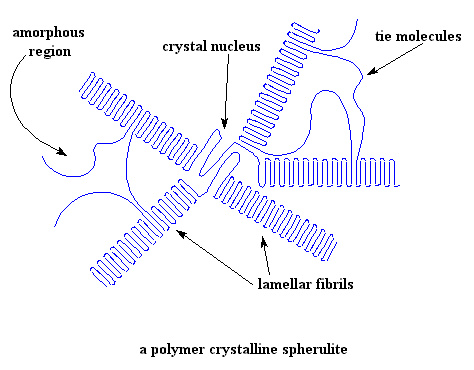
But if this is true, why does high-density polyethylene (HDPE, No. 2), made of linear polymer chains, have a lower tensile strength than its cousin branched low-density polyethylene (LDPE, No. 4)? This is due to crystal packing. When polymer strands organize, they form microcrystalline regions surrounded by amorphous, glassy regions.

Fig. 4: Crystalline and amorphous polymer structure (Polymer Science Learning Center)
Being linear allows HDPE to organize into a higher crystalline content than LDPE, and the extra intermolecular forces associated with these crystalline regions makes HDPE harder to deform than its other form. Fun fact, polymer crystallinity also has an effect on opacity in the same way the amorphous nature of glass causes its transparency, crystalline regions generally being more opaque than amorphous regions.

Due to their low capacity for biodegradation, the ubiquitous use of plastics in our society poses a serious problem for many environmentally-concerned individuals, and for good reason. Current plastic recycling programs are, to be frank, lacking, and this is majorly brought on by the economic limitations of recycling. Cultural attitudes towards sorting trash and recycled products also affect the efficacy of recycling programs. However, grass-roots activism and local- and national-level legislature are quickly changing opinions on the matter of plastic recycling. Knowing which plastics are recyclable (PETE, No.1, and HDPE, No. 2, only in many areas) will help to reduce the cost of sorting recyclables with a little effort, and public pressure for wider recycling programs may light a fire under companies to increase recycling, assuming the science exists. Research related to the synthesis of biodegradable polymers has picked up in recent years to produce products like polylactic acid (PLA, No. 7 (other)), but subsidies or funding is always welcome with science. If you're interested, these are things to talk to your local government representative about. 

So there you have it, a brief overview of the chemical and structural background of plastics (and a little bit on the side). Plastics are quite complicated and therefore impossible to talk about in depth through any medium shorter than a book, but if you want to hear more about specific aspects of polymers let me know in the comments and I’ll be happy to do so. Thanks!