Fish Poisons for Anesthesia

I stumbled across a bizzarre video in my recommended videos feed on YouTube yesterday that shows a goldfish getting surgery on his head growth blocking his vision (Note: this video is not for people who are squeamish, although there is no blood):


The video was an interesting find overall, simply because it had no actual correlation with any videos in my watch history. I haven’t watched videos on fish or surgery, so to be recommended with a video featuring both was unusual. To be honest, while I was engrossed by the goldfish surgery, what made me keep watching was the maker, Colum’s Aquaponics’, use of clove oil to sedate the fish.

This brought two thoughts to my mind. The first was that clove oil has been recommended by traditional herbal medicine for toothaches. Typical application may have entailed chewing a clove or putting it between the gums and cheek next to the painful area. According to Colgate, clove oil has also been on the rise as a form of alternative medicine for oral pain in recent times as well [1]. Clove oil contains the chemical eugenol that is responsible for its anesthetic properties and is also used in refined form for modern dental applications [2]. Eugenol is a substituted guaiacol, making it related chemically to other plant compounds like vanillin though with very different effects [3]. Seemingly unrelated, this link between analgesia in humans and anesthesia in fish makes the use of clove oil to numb a surgery appear plausible to me, though a stretch.

Fig. 1: Eugenol, a fish anesthetic found in clove oil (Wikimedia)

The second was that in ancient Hawai’i, there was a method of fishing that involved lacing a stream or tide pool with a plant tincture to sedate the fish and cause them to float to the surface. The plants used included ‘ahuhu (Tephrosia purpurea) containing the fish toxin tephrosin and ‘akia (Wikstroemia oahuensis) [4(published in 1921, source must be treated as a work of its time),5]. Looking at some pictures of ‘akia on the internet, I immediately recognized the plant to have grown all over my elementary school campus back home. That’s pretty weird to think about, but it also makes me feel like I’ve missed out on an opportunity for some fun experiments.  

Fig. 2: 'Akia plant leaves and flowers ('Imiloa)

Hawai’i is not the only place to have practiced poison fishing, though in general the practice is considered destructive and paralleled to other wide-effect fishing methods like blast-fishing. And of course, the limited reach of poison fishing would be no match for the current global demand for fish. Yet while this fishing technique has been passed by in modern times, the plants and chemicals once used for fishing may now find new applications, namely in fish anesthesia for aquatic veterinary care.


I hope you enjoyed this short blurb on the interesting topic of fish anesthesia, and be sure to leave a comment and share your thoughts on the post. These past few weeks have been busy in school, and the first wave of midterms (UPenn doesn’t understand the term “midterm”) has started to hit. I do believe I will be able to post at least every other week, however, as seems to be my current posting schedule, so be sure to look out for future posts. As always, thanks for reading!  

Insights into Early Hominin Communication

A recent article published in Science looked to the skull shapes of early hominins, a group comprised of our now-extinct closest ancestors and ourselves, as a prediction of what sort of auditory sensitivity they were capable of, with interesting results. The shape and size of the auditory apparatus in animals affects the intensity with which each frequency register is perceived. In the study, the inner ears of early hominins, chimpanzees and modern humans were scrutinized, and the modeled ear parts of each were used to make predictions regarding the frequencies that were more easily heard, and the results were plotted as shown below. 

Fig. 1: Sensitivity to sound over a range of frequencies (article in discussion)

In the figure, the y-axis corresponds to the log of the ratio of sound power to reach the cochlea, Pcochlea, versus that of the sound source, Po, as a measure of the perceived sound intensity. The researchers conducting the study were able to show that the early hominins had a higher sensitivity to sound at around 3kHz than both chimpanzees and modern humans and generally higher sensitivity to lower frequency sounds as well, showing a decrease in sensitivity at higher frequencies that is more similar in trend to the hearing curve of chimpanzees than it is to humans. Modern humans, in contrast to the others, have a similar sensitivity curve at lower frequencies but extend hearing to higher frequency sound, dropping off near 4kHz frequency. In analyzing this finding, the researchers came to the conclusion that the adaption to a wider frequency range of hearing in modern humans was imperative for the development of consonants in human language. The researchers considered that the phonemes t, k, f and s in particular are associated with higher frequency sound and that the ability to perceive sound over a wide range of frequencies makes these sounds more distinct from each other. Since early hominins were incapable of perceiving the upper frequency range that modern humans can, the researchers postulate that communication between the early hominins would have been vowel-intensive. They make a point, however, of stating that this finding does not confirm any information about the extent to which early hominin language was used or developed; early hominins may have used a “low-fidelity social transmission” form of communication similar to that of modern chimpanzees. Nevertheless, the skulls of these early hominins have given us another insight into what life was like for some of our earliest ancestors.

The complete article on the differences in sound perception described above is available here. While the article is heavy on jargon, the results and discussion sections can be understood without fully understanding the early talk of ear anatomical differences. 

Also, please let me know your thoughts on this trial article in the comments. I am trying something new with the posts here, providing brief summaries of emerging science rather than explanatory articles of everyday phenomena. Feedback helps me decide what content I post. Thanks!

Approaching Herbalism from a Scientifically Literate Perspective

Is there really a founding for believing in herbal medicine? This seems to be a question many Americans are asking in a time when the concept of “human is better” is waning in favor of a return to an attitude that acknowledges we have a lot to learn from nature. Much of herbal medicine may seem like hocus-pocus, but scientists are not as against herbalism as some would think.

A first thought when someone mentions herbal medicine might be something along the lines of dried seahorse and mummified gecko. This is especially true for Americans where there is a high Chinese cultural medicine presence and where such practices are often caricaturized by the media. However, not all herbal medicine is so strange. Some common examples of herbal medicine practice could be honey-ginger tea for a sore throat and aloe (Aloe vera) for sunburns, both of which can be commonly bought in major store chains. As it turns out, much of the world uses some form of herbalism [1]. This shouldn’t come as a surprise. It is against human nature to accept illness as it comes, so wherever there are people there is likely to be medicine as well. But living in the time we do, both traditional herbal medicines and contemporary scientifically produced medicines are readily available. So which should we choose?

Fig. 1: Herbal medicine utilization by country (ClubNatu, same as source 1)

Herbal medicine is steeped in traditional medicine practices that developed before the scientific method and its instruments were available. Yet even so, many herbal remedies have come about through a rather logical process. Take even a fictitious, highly religious pre-scientific society where medicines are attributed to gods. If a medicine doesn’t heal its patient, then the instinct is to throw it out primarily because it’s useless and perhaps also because it makes the gods look bad. Our ancestors were smart enough to develop a working knowledge of herbs through thousands of years of trial and error, a highly valued logical test still used today in medicine development.

The argument some give in favor of a return to herbal medicine is that it’s more “natural” than modern synthetic drugs. This is not a well-based argument from a scientific perspective. Instead, we should consider factors such as effectiveness, side-effects, general safety of the herbs and the ecological impacts of its widespread prescription, each of which must be individually assessed per herb. The effectiveness of herbal remedies is a subject of increasing research attention as many have proven to possess clinical efficacy. Aspirin, for example, emerged from a more mild treatment of salicylic acid, a chemical found to exist in the bark of the white willow (Salix alba) tree used in traditional medicine. It has recently become a growing practice to scientifically test a wide number of natural products and traditional remedies as a high-throughput system for scouting out potential new treatments. Some herbal remedies have also been found to offer their effects with less side effects than modern medicine [2]. This could be due to a plethora of possible reasons including active dosage or the presence of other compounds to neutralize negative effects.

Fig. 2: Most popular natural products (including herbs) in the United States (NCCIH)

So where do herbal medicines fall short? All medicines have their associated risks, but a lack of herbal toxicity knowledge and of prescription guideline enforcement brings into question the safety of some herbal medicines [3]. The ecological effects of manufacturing herbal medicines must be considered as well. Paclitaxel, a drug with anti-tumor properties listed on the World Health Organization’s List of Essential Medicines, is a natural product from the bark of the Pacific Yew (Taxus brevifolia) tree [4]. However, wild-crafting this compound would devastate the tree population. Thus there is an inherent economic limitation on herbal paclitaxel, and so the synthetic generation of this natural compound is now the main route of production.

Herbal medicine is a topic that has been making a comeback under the realization that we have much more to discover about our medical pasts through a scientific approach. Personally, I am inclined to believe this is a step in the right direction since it is never bad to know more about plants that could potentially save our health. After all, it takes just one paclitaxel to make the search worth it. Social opinions on herbalism as a form of alternative medicine are shifting towards the positive, and as scientifically educated individuals we should keep ourselves updated on this movement.  

Primary Colors: Why One Set Wouldn't Suffice

Colors are a ubiquitous fact of human life. Imagine a world without colors; all of the great masterpieces would be painted in gray scale, that potato could be purple or brown and there would be no more blue skies. Experientially, we are highly familiar with the concept of colors, but I would say it isn’t common to understand the more technical side of the world of colors. Let’s explore this more analytical side and it’s applications as we try to answer a question most of us have probably had: why are there multiple sets of primary colors?

At the most basic, colors are categories of light within the visible spectrum that can be described as having either different wavelengths or frequencies since the two variables are directly correlated by the equation

                     1. c=λv (c is the speed of light, λ is wavelength and v is frequency)

The visible spectrum is comprised of the rainbow colors describe by the acronym ROYGBIV (red, orange, yellow, green, blue, indigo and violet). 

Fig. 1: Visible spectrum for humans (Arstechnica)
White is the presence of all wavelengths while black is the absence of light. Technically, there is no physical meaning associated with colors since the color spectrum is defined based on human capacity to perceive and differentiate different colors. That is to say, the visible spectrum and colors would be defined very differently had we been insects able to see UV light [1]. So keep in mind that all of this talk of analyzing colors is human-specific and don’t go off trying to explain it to your dog.

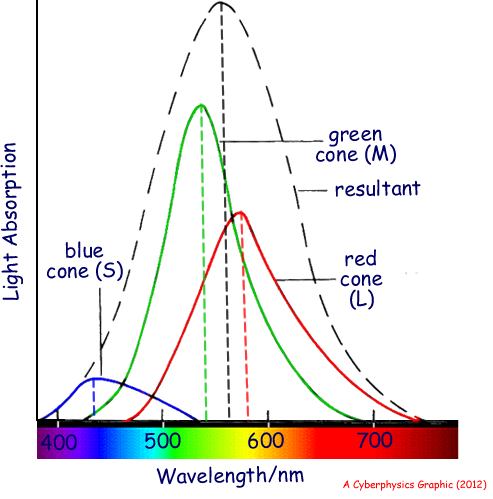
The human eye consists of rods, which perceive low intensity light, and cones, which perceive colors and high intensity light [2]. There are three types of cones, dubbed L, M and S, that respond to different wavelengths of light. The peak sensitivities for these three cone types are 580nm (red), 540nm (green) and 440nm (blue) respectively, adding to a maximum sensitivity at 560nm (in the yellow-green region of the spectrum) [3].

Fig. 1: L, M and S cone response curves and response sum (Cyberphysics)

This should start to sound familiar for those of you who are familiar with the concept of primary light colors or who have ever squinted really hard at a television screen. Aside from these three colors, other colors are perceived by simultaneous stimulation of multiple cone types. The color mixing ratios of red, blue and green light to perceive every color was actually indexed in 1931, creating the RGB CIE 1931 system [4]. The impact of breaking each color into three values of red, blue and green, called the RGB tristimulus values, is that each color can now be defined in three-dimensional space as a combination of three basis vectors representing red, blue and green relative intensity values. The mathematical derivation can be found in reference 4, but the result is the chromaticity diagram familiar to aficionados of tech wanting to know what range of human-perceivable colors their devices are capable of displaying. Look along the edge of the chromaticity diagram and you should find a color wheel for light.

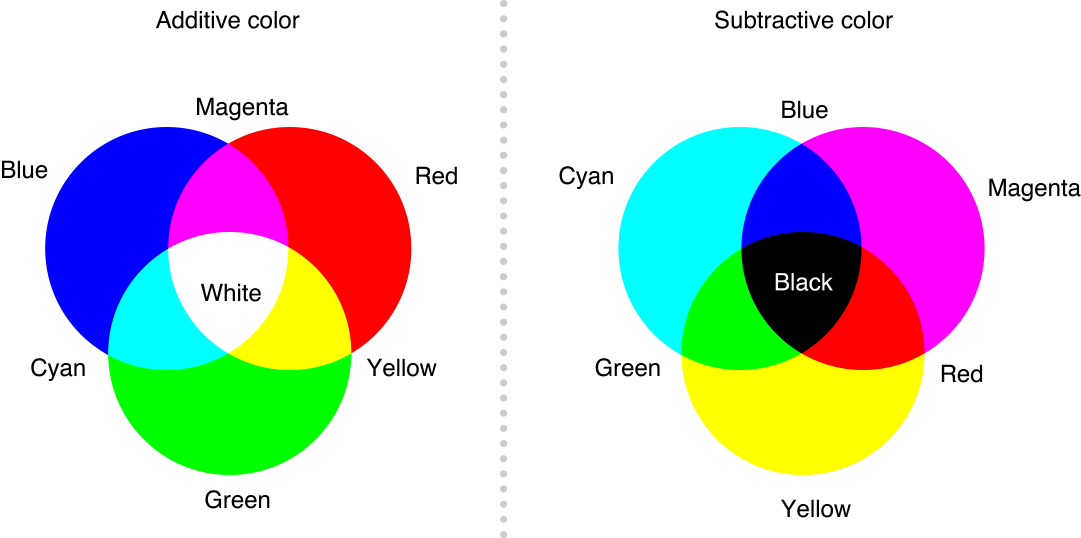
So far we have one set of primary colors consisting of red, blue and green that has widespread applications in electronic devices since many of these generate colors for humans to perceive when watching movies or reading billboards and such. But this set of primaries and its corresponding wheel only apply to the production of light by adding ranges of wavelengths together. This is called additive color. When light is absorbed by colored materials via quantum effects, as has been described in Thoughts in Black Ink, the color perceived is the light range that has not been absorbed. To describe the phenomenon of light absorption to generate a reflected color, the painter’s wheel was invented by Isaac Newton in 1666 [5] with the familiar primaries of red, blue and yellow. What this wheel describes is how subtracting light with certain ranges of wavelengths stacks to reflect light of a certain color when starting with ambient pan-frequency white light. However, this is not strictly subtractive color because the painter’s wheel adds to brown, not black as anyone who has tried to make black paint from the primaries in art class knows. The subtractive color wheel is defined with yellow, magenta and cyan as primaries and should be familiar as the different ink cartridges you probably put in your printer so that your computer can print black in theory (but black ink is cheaper).

Fig. 2: Additive and subtractive color (Mac Developer Library)

Why these three colors? It turns out that if you take the three primary colors of light, red, blue and green, and combine them two at a time, you get cyan, magenta and yellow [6]. And since the color of a surface is what the surface doesn’t absorb, each subtractive primary color cancels out one of the additive primary colors until no light is left. And there you have it, the three most common primary color sets.

This post was made in response to a comment by my friend Lilia back on the article How Soap Helps Us Clean. I haven’t address the comment until now because I knew there would be a biological component to this explanation and cellular biology is not my strong suit, hence the brevity with which I describe the rods and cones of the eye. But if you guys have anything you would like to hear about, feel free to leave suggestions in the comments below and I will do my best to write a post for you. Thanks!

The Logic Behind an Era of Safe Canning

Canned food is something that most everyone is familiar with. From canned sardines to peaches to condensed milk, canning food is a useful preservation method for our favorite foods. Better food preservation in turn means that the foods we love are available year round. Iconically, the ridged metal can comes to mind, but there are other forms of canning that involve glass jars with metal lids used primarily for home canning but also seen sometimes in stores.

Fig. 1: A sample of canning styles (Best in Packaging)

Many families can their own excess garden goods at home to eat later; according to the CDC, 1 in 5 American households participate in home canning [1]. There are two main sterilization methods used in home canning, one involving boiling the cans and the other involving high temperatures as well as high pressure [2]. Heat kills bacteria, mold and other bad stuff for reasons previously discussed in Party Science, Part 3: The Tasty Grub. However, for the same reason that bacteria are killed by heat the flavor of the preserved food may be affected as well. Pressure kills bacteria possibly as an effect of the expansion of dissolve gases within bacterial cells [3]. Acidity is another factor that affects bacterial survival, and it has been found that acidic foods inhibit the growth of pathogenic bacteria enough to permit the use of High Pressure Processing (HPP) as the only additional sterilization technique while basic foods such as meats require heat treatment as well [4]. 

In our current era when canning is considered a generally understood science, it is uncommon to hear of botulism cases from canned foods, especially those produced commercially. Botulism is the name of an illness caused by Clostridium botulinum bacteria that generate botulinum toxin. There are eight different forms of botulinum toxin labeled types A through G (botulinum toxin C is divided into C1 and C2), of which type A is the most potent and types A, B and E are associated with human botulism. Botulinum toxin is one of the most poisonous known biological substances and also happens to be the active ingredient in Botox injections. Botulinum toxin binds to receptors on the presynaptic surface of neurons and is accepted into the neuron where it interacts with proteins related to acetylcholine vesicle transport to prevent the neurotransmitter’s release [5].

Fig. 2: Botulinum toxin mechanism of action (Student Pulse)

Symptoms of botulism are typically those related to an impaired nervous system, such as blurred vision, muscle weakness, slurred speech, drooping eyelids and difficulty swallowing. The presentation of these symptoms after possible botulism exposure is an emergency situation as antitoxins exist to treat botulism if administered promptly and progressed botulism may be fatal due to respiratory system paralysis [6]. 

But botulism and other canning-related illness cases today are rare and for the most part, the effects of canning have been positive for human survival during harsh times and the winter season. I for one love having corn, my favorite vegetable/grain thing, available all year round, and for that I am thankful we have this technology. How about you? Let me know what you think in the comments below, and check out this link to an instructional video if you are interested in canning your own foods at home.